
Volume no :
9 |
Issue no :
1
Article Type :
Research Article
Author :
1Mr.K.Murugan, 2R.Kamaleshwari, 3E.Akshaya, 4J.Kaviya Sri
Published Date :
May, 2025
Publisher :
Journl AI & CS
Page No: 1 - 10
Abstract : Urban drainage systems in many cities frequently face issues like blockages, accumulation of uncleaned waste, and inefficient maintenance, leading to severe consequences such as urban flooding, environmental degradation, and increased public health risks. To address these challenges, the Automated Drainage Monitoring System (ADMS) introduces an innovative, technology-driven approach leveraging the power of IoT, artificial intelligence, and real-time communication. Smart IoT sensors are strategically deployed within the drainage network to monitor key parameters such as water levels, flow rate, and the presence of solid waste or toxic substances. These sensors transmit continuous data to a cloud-based platform where AI-driven analytics process the information, identify abnormal patterns, and predict potential blockages or overflows before they occur. Upon detection of a critical condition, automated alerts are sent to municipal authorities and maintenance teams through a dedicated web and mobile application interface. This platform not only enables real-time monitoring and data visualization but also facilitates the generation of analytical reports and allows for community feedback submission. By automating inspection and reporting processes, ADMS minimizes the need for manual interventions, ensuring timely and proactive maintenance. This system directly supports Sustainable Development Goals (SDGs), including clean water and sanitation (SDG 6), sustainable cities (SDG 11), and climate action (SDG 13), ultimately fostering a cleaner, safer, and more resilient urban environment.
Keyword Automated Drainage Monitoring System (ADMS), IoT sensors, anomalies detection, predict blockages, municipal authorities, web application, mobile application, real-time monitoring, reports, Sustainable Development Goals (SDGs.
Real-Time Drainage Maintenance and Monitoring

AI-Enhanced IoT-Based Waste Management System

This innovative system goes beyond technical advancement. It aligns closely with key Sustainable Development Goals (SDGs).

It supports SDG 6 (Clean Water and Sanitation) by preventing water contamination and promoting hygienic waste disposal. The system also contributes to SDG 11 (Sustainable Cities and Communities) by improving infrastructure resilience and making urban spaces more livable IoT based Waste Management System.

In addition, it plays a key role in SDG 13 (Climate Action). Its environmental monitoring and proactive risk mitigation help cities prepare for climate-related hazards like heavy rain and urban flooding.

Traditional drainage maintenance relies on periodic manual inspections. These are time-consuming, labor-intensive, and often inefficient. They also risk missing early signs of failure, which can lead to serious damage and public disruption.

In contrast, the Automated Drainage Monitoring System (ADMS) provides a smart, scalable solution. It ensures continuous, real-time surveillance of drainage infrastructure..

IoT based Waste Management System

The integration of smart technologies in urban infrastructure is essential to address the growing challenges of rapid urbanization. This is especially true for drainage management and environmental monitoring.

The integration of smart technologies in urban infrastructure is becoming increasingly essential. Specifically, it addresses the growing challenges posed by rapid urbanization, particularly in drainage management and environmental monitoring.

Traditionally, drainage systems have been maintained through manual inspections and reactive measures. However, these approaches are often inefficient and fail to prevent issues such as blockages, environmental hazards, and health risks.

IoT based Waste Management System

To address these limitations, researchers have begun leveraging the Internet of Things (IoT), Artificial Intelligence (AI), and real-time data processing. As a result, intelligent monitoring systems have been developed to improve efficiency and ensure proactive management.

For instance, Al-Garadi et al. [1] conducted a comprehensive survey of machine learning algorithms relevant to smart city infrastructure. According to their findings, AI can analyze real-time data from diverse sources. Consequently, such models can anticipate system failures and optimize urban services, making them ideal for smart drainage applications.

Similarly, Latif et al. …

AI-Enhanced IoT based Waste Management 
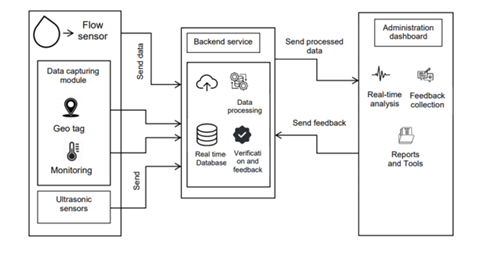
FIGURE 1: The System Architecture for AI-Enhanced IoT based Waste Management System for Real-Time Drainage 
Maintenance and Monitoring

indexed in

Download